


Transforming Vehicle Access: The Integration of UHF, ANPR, and Boom Barriers

Vehicle access control plays a crucial role in managing security, convenience, and traffic flow in various settings such as residential complexes, corporate campuses, parking lots, and toll plazas. Traditional methods often rely on manual checks or simple card readers, which can cause delays and security gaps. Today, combining UHF (Ultra High Frequency) RFID technology, ANPR (Automatic Number Plate Recognition), and boom barriers creates a truly smart vehicle access system that enhances efficiency, safety, and user experience.
This post explores how these three technologies work together, their benefits, practical applications, and what to consider when building such a system.
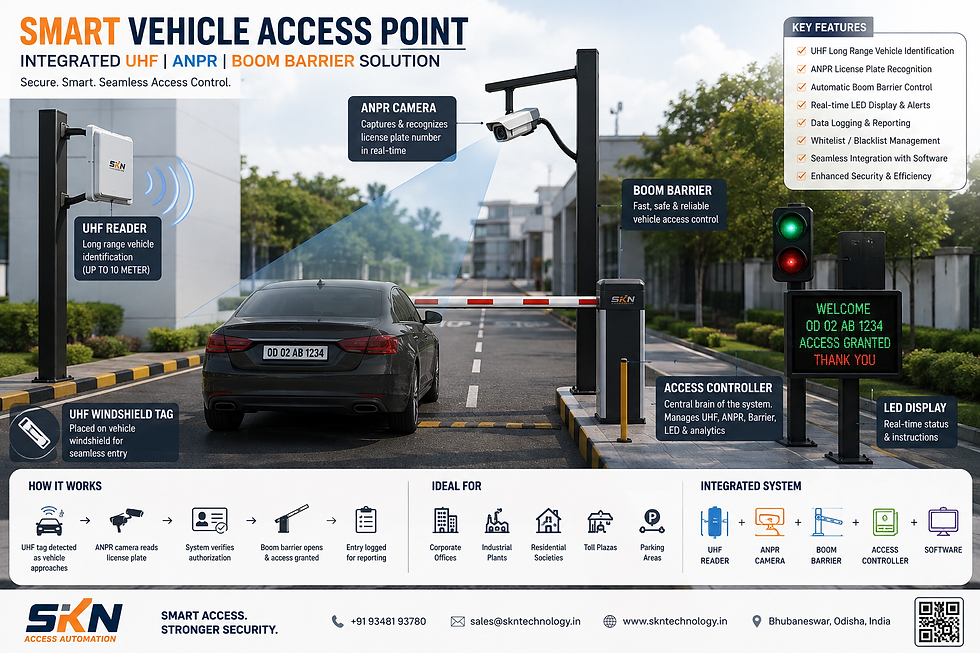
How UHF RFID Technology Enhances Vehicle Identification
UHF RFID uses radio waves to identify tags attached to vehicles from a distance, typically several meters. This technology offers several advantages for vehicle access:
Fast and contactless identification: Vehicles do not need to stop or slow down significantly to be recognized.
Long read range: UHF tags can be read from 4 to 10 meters, allowing early detection.
Durability: RFID tags are weather-resistant and can be embedded in windshields or license plate holders.
Cost-effective: Tags and readers have become affordable for large-scale deployment.
In practice, a vehicle equipped with a UHF RFID tag approaches the gate. The reader detects the tag and sends the vehicle ID to the access control system. If authorized, the boom barrier opens automatically.
Example: A gated community issues UHF RFID tags to residents. When a resident’s car approaches, the system reads the tag and lifts the barrier without any manual intervention, reducing wait times and improving security.
The Role of ANPR in Vehicle Access Systems
ANPR uses cameras and image processing software to read license plates automatically. It adds a layer of verification and flexibility:
Non-intrusive identification: No need for physical tags; the system reads plates directly.
Works for visitors and temporary vehicles: Plates can be checked against a database or flagged for manual review.
Supports enforcement and record-keeping: Captures images and timestamps for audit trails.
Integration with databases: Can cross-check plates against watchlists or subscription lists.
ANPR complements UHF by providing a backup or alternative identification method. For example, if a vehicle does not have a UHF tag, the ANPR system can still identify it and decide whether to grant access.
Example: A corporate parking lot uses ANPR to allow visitors who register their license plates in advance. When the visitor arrives, the system recognizes the plate and opens the boom barrier without requiring a security guard.
Boom Barriers as the Physical Control Element
Boom barriers act as the physical gate that controls vehicle entry and exit. Their integration with UHF and ANPR systems ensures smooth operation:
Automated operation: Opens and closes based on signals from identification systems.
Safety features: Sensors prevent the barrier from closing on vehicles.
Traffic management: Can be programmed to handle different vehicle types or priority levels.
Integration with alarms and intercoms: Allows manual override or communication if needed.
The boom barrier is the final checkpoint that physically restricts or allows access, making it a critical component of the system.
Benefits of Integrating UHF, ANPR, and Boom Barriers
Combining these technologies creates a system that is more than the sum of its parts. Key benefits include:
Improved security: Dual identification methods reduce the risk of unauthorized access.
Faster vehicle throughput: Contactless UHF reading and quick ANPR recognition minimize waiting times.
Flexibility: Supports residents, employees, visitors, and delivery vehicles with different access rules.
Reduced labor costs: Automation reduces the need for security personnel at gates.
Data collection and analytics: Logs of vehicle entries and exits help with planning and security audits.
Practical Considerations for Building a Smart Vehicle Access System
When designing and implementing a system that integrates UHF, ANPR, and boom barriers, consider the following:
Site Assessment
Traffic volume: High traffic areas require faster readers and cameras with quick processing.
Lighting conditions: ANPR cameras need good lighting or infrared capabilities for night recognition.
Environmental factors: Weatherproof equipment is essential for outdoor installations.
Technology Selection
UHF tags and readers: Choose tags compatible with vehicles and readers with suitable read range.
ANPR cameras: Select cameras with high resolution and reliable plate recognition software.
Boom barriers: Ensure barriers have safety sensors and can integrate with control systems.
Integration and Software
Use a central access control platform that can process data from both UHF and ANPR.
Implement rules for access decisions, such as prioritizing UHF tag reads but falling back to ANPR.
Ensure real-time communication between devices for smooth operation.
User Management
Maintain an updated database of authorized vehicles and tags.
Provide easy registration for visitors and temporary users.
Use alerts and reports to monitor unusual activity.
Real-World Example: University Campus Access Control
A large university installed a vehicle access system combining UHF, ANPR, and boom barriers at all campus entrances. Students and staff received UHF tags linked to their IDs. Visitors registered their license plates online before arrival.
Vehicles with UHF tags were recognized instantly, and barriers opened automatically.
Visitor plates were checked by ANPR cameras, and security personnel were alerted if a plate was not registered.
The system logged all entries and exits, helping campus security monitor traffic and respond quickly to incidents.
This setup reduced congestion during peak hours and improved overall campus safety.
Future Trends in Vehicle Access Systems
Emerging technologies will further enhance these systems:
AI-powered ANPR: Improved accuracy and ability to recognize plates from different regions.
Mobile credentials: Using smartphones as virtual RFID tags.
Cloud-based management: Remote monitoring and control of access points.
Integration with smart city infrastructure: Coordinated traffic management and emergency response.
Smart vehicle access systems that combine UHF RFID, ANPR, and boom barriers offer a practical solution to modern security and traffic challenges. By using multiple identification methods and automating physical control, these systems provide fast, reliable, and flexible access management. Whether for residential communities, corporate campuses, or public facilities, this integration improves safety and convenience while reducing operational costs.
Consider your specific needs and environment to choose the right components and design a system that works seamlessly. The future of vehicle access is smart, connected, and efficient.


Comments